

A minor in applied artificial intelligence (AI) makes every degree stronger

AI skills will make you stand out

When you send your resume to your first potential employer, a minor in applied AI will show  them that you’re familiar with uses and implications of the world’s fastest growing innovative tools.

Employers are aware that every industry – from industrial engineering, to food science, to interior design, to chemistry – can benefit from applying AI, but some may not yet know how. With Iowa State’s minor in applied AI, you’ll learn how AI is integrated into a broad range of industries, and the impact it has on individuals and communities. You’ll bring a knowledge of AI tools and technologies that will be valuable in your future workplace.

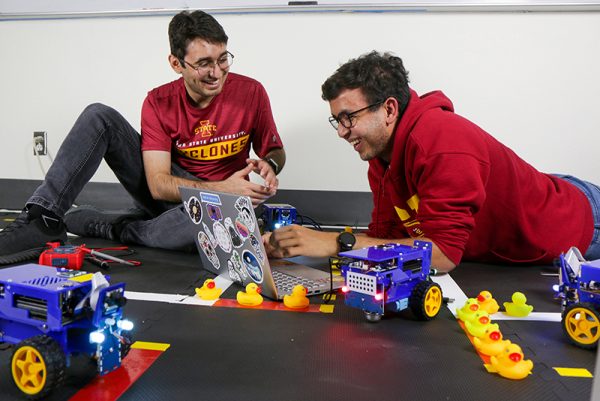
Group of students using AI in class

A minor for all students

The minor in applied AI is designed to give all undergraduate majors at Iowa State the opportunity to learn about how AI is applied in our world. Whether you’re studying agriculture or architecture, you’ll learn:

  • How to use low-code or no-code AI tools
  • How to use data with or from AI tools
  • Social, cultural, and global impacts of AI
  • Legal and regulatory frameworks
  • Ethical considerations of AI

The applied AI minor is relevant to every industry

  • Medicine

    AI is creating faster, more efficient techniques for predicting, identifying, and treating disease. It’s also making healthcare more accessible with remote and 24-hour patient care.

  • Retail

    AI tools provide personalized shopping with intuitive insights from anywhere, with optimized pricing tools and improved inventory management.

  • Supply chain

    AI tools help reduce waste and create better forecasting for demand, inventory, warehouse spacing, transportation, and delivery.

  • Banking and financial

    AI reduces fraud, automates risk assessment, and provides safety alerts and suggestions for investors or clients.

  • Manufacturing

    AI tools detect defects faster, streamline processes, predict equipment failures, and provide real-time data.

  • Transportation

    AI tools can contribute to traffic safety and efficient and real-time mapping of routes.

  • Education

    AI tools can provide students feedback and tutoring as they write and read and  help teachers grade and evaluate assignments.


  • Agriculture

    Managing livestock and crops is more efficient and productive when using AI forecasting, tracking, and navigation tools.

  • Entertainment & Hospitality

    Movies, written works, and social media get a boost from AI tools that help edit and augment, while AI language translation and algorithms provide better customer experiences.

Autonomous VehiclesWhat classes you’ll take

Learning how to apply AI tools is like learning to drive. You may not need to work under the hood of your car, but you do need to know how to drive it. The classes you take will prepare you for the road ahead.

The minor in Applied AI has two required courses and three electives. You’ll get to take classes with students from all majors across campus and build connections with faculty and peers outside of your department.

15 credits to a game-changing minor

AI 2010: Introduction to Applied AI

Broad introduction to AI, focusing on its applications and impact across different fields and industries. Provides an overview of AI concepts, terminology, and real-world examples, allowing students to understand how AI is transforming various domains. Basic introduction of societal implications, ethical considerations, and potential challenges associated with AI. Opportunities to collaborate and use AI to address real-world challenges.

AI 2020: Ethical Design, Use, and Impact of AI

Real-world examples of ethical challenges posed by artificial intelligence (AI) technologies. How artificial intelligence affects users, the public, and society, domestically and globally. Responsibilities of AI designers, as well as public and private institutions, to those affected. Course is open to students from any major.

In addition to these two required classes, choose 3 electives (9 credits) from approved classes. If a course is not listed as currently approved but you think it should count as an elective, please contact professor in charge, Annemarie Butler, at butlera@iastate.edu.

Approved courses

Course Number Course Title
ABE 5160 Data Science and Analytics for Agricultural and Biosystem Engineers
ANTHR 3160X Anthropology and Artificial Intelligence (AI)
ART 3400X Artificial Intelligence (AI) in Art and Design
COMS 4720 Principle of Artificial Intelligence
COMS 4740 Introduction to Machine Learning
COMS 4760 Motion Planning for Robotics and Autonomous Systems
COMST 3300 Communication in a Digital World
DS 2010 Introduction to Data Science
DS 3010 Applied Data Modeling and Predictive Analysis
EDUC 4410X Human-Centered AI in Education: Foundations and Applications
EDUC 4540* Emerging Topics in Educational Technology
EE 4250 Machine Learning: A Signal Processing Perspective
EE 4280 Image Analysis using Machine Learning
ENGL 1200/LING 1200 Language and Technology
ENGL 2220 Artificial Intelligence and Writing
ENGL 32060X/LING 3260X Human Language and Generative AI
ENGL 4100/LING 4100 Language as Data
IE 4830 Data Mining
IE 4870 Big Data Analytics and Optimization
INDD 4450X Concept to Spotlight — AI Enhance Digital Storytelling
JLMC 4740 Communication Technology and Social Change
MATH 4220X/DS 4220X Mathematical Principles of Data Science
ME 2800 Desing and Analysis of Cyber-Physical Systems
MIS 4360 Introduction to Business Analytics
MIS 4460 Advanced Business Analytics
MKT 4560X Digital Marketing Analytics
PHIL 3430 Ethics of Computing and Artificial Intelligence
PHIL4650 Brains, Minds, and Computers
PSYCH 3500 Human Factors in Technology
SOC 3800 Sociology of Work, Organizations, and Technology

* EDUC 4410X can only be used when the topic is: Introduction to AI in Education.