Research

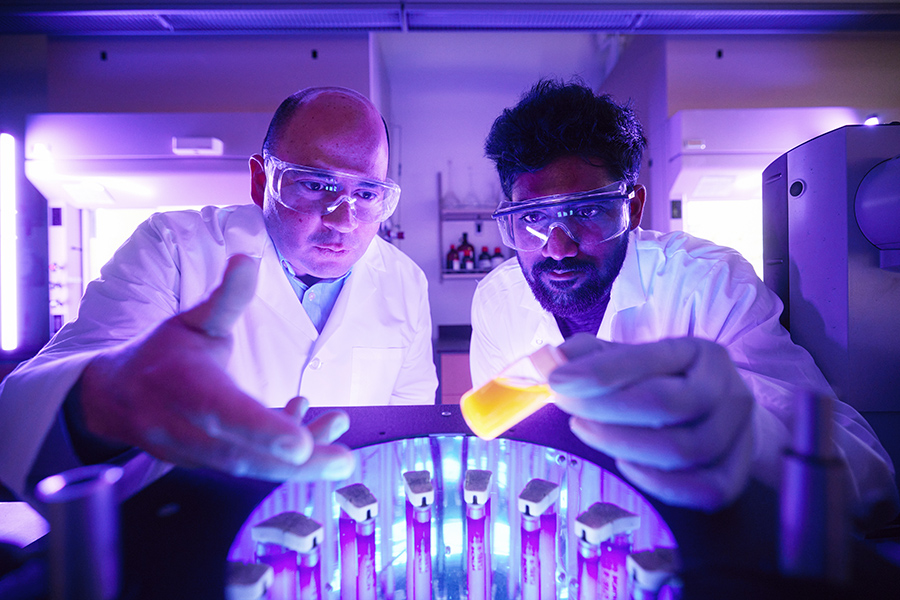
Wenyu Huang, Ph.D in the lab

We’re changing the world with research and innovation

Every day, scientists and scholars in Iowa State’s academically diverse College of Liberal Arts and Sciences (LAS) positively impact Iowa, the nation, and the world with innovative research that pushes the boundaries of science, technology, and the humanities.

Whether it’s in one of our neuroscience or robotics labs or in a state-of-the-art classroom, our community of LAS researchers is forging new paths – both individually and collaboratively.

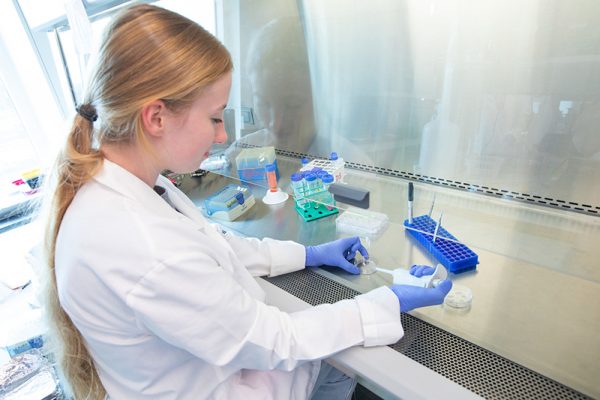
Student conducts experiment with stem cells in a labStudent discoveries in the making

Undergraduate research is a key component of experiential learning, so LAS encourages undergraduate and graduate students to work with faculty to develop solutions to pressing global challenges. Our students are integral to research efforts, in areas such as energy security, mental health, or cancer treatment. We even have special paid opportunities for undergraduate research.

Creative collaborations

To address the grand challenges of our generation and enable new discoveries, many LAS researchers form collaborations across disciplines and continents. From the U.S. Department of Energy’s Ames Laboratory here on campus to government, industry and community partners across Iowa and the world, we build teams to drive research for the common good.

But we don’t stop there. LAS is preparing students to work in interdisciplinary fields. Our new integrated health sciences degree brings together LAS research strengths and knowledge from disciplines such as genetics, statistics, the humanities, and others from across the university.

True success

We are proud of our faculty members who have been elected to the National Academy of Sciences and earned the National Science Foundation’s prestigious NSF CAREER award. However, the depth of our pride resides in the research conducted by our LAS students and faculty, which truly makes a difference in the world.

Our research matters

Recent discoveries

  • ‘Atomic snapshots’ of proofreading enzyme could lead to better COVID-19 drugs

    A research team led by Yang Yang used images from a cryogenic electron microscope to better understand why a common type of antiviral drug struggles to fight off the virus that causes COVID-19, findings that will guide designs for more effective treatment.
  • For autonomous robots, not all rules are equal

    Autonomous robots can follow rules — but what happens when the rules conflict? LAS researchers have developed a new “rulebooks” framework that helps robots make safer, more transparent judgment calls when perfection isn’t possible.
  • LAS researchers discover that pollinators help maintain plant biodiversity

    A recent study by Brian Wilsey, professor of ecology, evolution and organismal biology, shows that pollinators help maintain plant biodiversity, suggesting that significant decreases in pollinators could cause a “plant-pollinator extinction vortex.”

Help us change the world